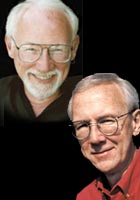




The year was 1939. Franklin Delano Roosevelt was in the White House. Hitler was waging war on Britain and France. The country’s 131 million people were lining up to see The Wizard of Oz, the Yankees won the World Series Championship, a loaf of bread cost 8 cents, and, on January 23, the Brothers Hildebrandt were born. Throughout their careers, Greg and Tim would work together and separately, and together again, winning awards, fame, and challenges as illustrators. They would create everything from the world famous poster for Star Wars, to the best-selling calendars illustrating J.R.R. Tolkien’s The Lord of the Rings, to their own fantasy novel, Urshurak. They would also work on advertising art, hundreds of classic children’s books, and the covers of numerous fantasy and science fiction novels. Together they have won the coveted Gold Medal from the Society of Illustrators. In 1973, the Child Study Association chose their Giant Panda Book as a Children’s Books of the Year. Tim won his Award of Merit at the Society of Illustrator’s Annual Show for the cover illustration of The Children of Arabel in 1987. At the ripe old age of two, the twins had already demonstrated the genesis of their artistic talents. Their mother recalls George, their father, teaching the boys to color with crayons. He noted that before long the twins had taken the crayons away from him, and were even coloring within the lines. The twins were strongly influenced by many of the great comic books and strips of the era, especially Green Lantern, Terry and the Pirates, Steve Canyon, Prince Valiant, Green Hornet, Wonder Woman, Batman, and Superman. Even at the age of eight, they emulated the artwork in these comics, getting their first, and often frustrating, lessons in anatomy and perspective. Greg and Tim were also captivated by other forms of fantasy: marionettes and puppets, especially Edgar Bergen and Charlie McCarthy; science fiction novels and films, including Frankenstein, and George Pal’s classics When Worlds Collide and The War of the Worlds; and illustrators, especially N.C. Wyeth and Maxfield Parrish. Perhaps the biggest artistic influence on the twins was the work of Walt Disney, specifically the animated features, such as Snow White and the Seven Dwarfs, and Fantasia. Tim has said, “Those works continue to give me inspiration, and I feel they are, as Peter Ustinov once said, among the wonders of the world.” Greg and Tim have both been asked to speak to the animation department of Disney on their use of light and color. The twins had dreamed of becoming Disney animators. They began with homemade, self-taught animation. This dream led them to their enrollment in Meinzinger’s Art School in Detroit, when they learned that all hopeful Disney animators must have some formal art training. While they did not ultimately work for Disney, they would become celebrated animators and documentary filmmakers, winning the Golden Eagle award for Project Hope. This film was a documentary chronicling the efforts of a medical relief ship, and innovatively combined live action with animation to tell its story. In 1963 Greg & Tim moved from Detroit to New Jersey. They came to work for Bishop Fulton J. Sheen. The Bishop sent Greg & Tim around the world making documentary films on hunger and poverty. The films were intended for high school use to raise awareness. Greg & Tim also created art for the Bishop’s TV show which aired weekly. In 1969 Greg & Tim decided to take a new path and began illustrating children’s books for Holt, Reinhart & Winston and other major publishers. This would consume them for the next six years. In 1975, the twins, then virtually unknown as artists, burst into the world of illustration, winning the opportunity to illustrate the 1976 Ballantine calendar based on J.R.R. Tolkien’s fantasy classic The Lord of the Rings. They went on to illustrate the Tolkien calendars for the next two years, with the 1978 calendar selling more than one million copies — a record. This sudden fame and exposure allowed the twins, now known as the Brothers Hildebrandt, extraordinary opportunities. They illustrated the best-selling novel by Terry Brooks, The Sword of Shanarra. For the movies, they painted a poster for a 1979 re-release of Barbarella, the 1981 fantasy film The Clash of the Titans, and the world-famous poster for the history making film Star Wars. Also, Tim created the poster for Don Bluth’s animated feature, The Secret of N.I.M.H. The Hildebrandt’s then went on to write (with friend Jerry Nichols) and illustrate their epic fantasy novel, Urshurak, which featured 16 full-color paintings and over fifty black-and-white illustrations — a publishing event which reached the New York Times Bestsellers List. The Brothers unsuccessfully attempted to turn Urshurak into a feature film. While the project interested several filmmakers, including Joseph E. Levine, Martin Bregman, and John Dykstra, it was ultimately considered to be too elaborate and costly to portray on film. At this point, in 1981, the Brothers separated to pursue their own individual careers, further developing their own styles and niches in illustration. Greg’s illustrations appeared on the covers and pages of several magazines, including Omni and Heavy Metal. Verkeke, one of the largest international poster companies, has reproduced many of his images. The Franklin Mint and Lenox have issued Greg’s work on collector’s plates, figurines, dolls, knives and swords. The Danbury Mint tested a new religious plate series created by Greg and a plate series based on his illustrations of J.R.R. Tolkien’s The Lord of the Rings. His art has been used in advertising for ABC and Dr. Pepper. Greg’s artwork has been licensed for such products as puzzles by American Publishing, greeting cards by Sunrise Greeting, and needlepoint canvases by Steiner Freres in Paris, France. His images have also been reproduced on eight sets of trading cards. In l984, Greg illustrated a calendar based on Mary Stewart’s widely acclaimed Merlin Trilogy; The Crystal Cave, The Hollow Hills, and The Last Enchantment. Greg has said, “Mary Stewart’s Merlin Trilogy is a major fantasy work with a large following...I had an incredible feeling that my art had satisfied Lady Stewart when I received a letter from her and she said that her words and characters were now moving around in my world.” Following in the tradition of many great illustrators, Greg went on to illustrate 15 classic and fairy tale collections for children. The series included: The Wizard of Oz, Aladdin and the Magic Lamp, Robin Hood, Dracula, and Phantom of the Opera. There are over 3,500,000 copies in print of the combined titles. The New York Times has said, “Fortunate the child or adult who receives a gift of classics richly illustrated by Greg Hildebrandt.” Greg’s artwork is collected by many famous people, some of whom include: Michael Jackson, Robin Williams, and the owner of WordPerfect Corporation. In February of 1993, Greg and Tim’s centerfold painting of “The Unexpected Party,” from the 1977 Tolkien Calendar, sold for $150,000. Upon completing a hidden image puzzle book on The Search for King Tut’s Tomb, Greg painted a cover for the DC Comics’ Spectre series. The comic book was awarded DC’s Cover of the Month. This piece also marked Greg’s first foray into the field which had so inspired him in his youth. Meanwhile, Tim had gone on to illustrate many calendars. Five of these calendars were produced for TSR--two for the Dungeons and Dragons series, and three for the Realms Of Wonder series. In 1984, Tim illustrated a calendar depicting Anne McCaffrey’s award winning novels The Dragonriders of Pern. Tim has painted the covers of numerous science fiction and fantasy magazines and books, including Starlog, Amazing Stories, Alan Dean Foster’s The Time of Transference, Poul Anderson’s The Byworlder, and Glenn Cooke’s Dream Brass Shadow. Tim also created porcelain Christmas Village for National Rennoc. His art was commissioned for the cover of the book The Illusion Of Life by landmark Disney animators Ollie Johnson and Frank Thomas. In 1990, Tim was invited to participate in a show given by the New York Society of Illustrators, entitled “The Artist and the Environment,” for which he painted The Bleeding Earth. His images have been used as advertising for AT&T and Levi’s, on packages for video games, such as the Parker Brothers game based on the film Return of the Jedi, and on game boards. Tim also completed illustrations for a proposed theme park in Kansas based on The Wizard of Oz. Later, Tim produced a plate series for Mermaids of the Sea and a Royal Copenhagen series on Danish Fairy Tales. He is currently working on a stop motion animated film entitled Dinosaur Rap. After 12 long but productive years, the Brothers Hildebrandt reunited. Although they have continued to pursue their individual careers, the bulk of their recent work has been created together. Their first collaboration was a Dragon Pop-Up Book for Little Brown. The brothers painted the dragons in pieces so that they would actually pop out of the book. They followed that up with a series of horror steins for Gerz, Inc., which were used for a Budweiser promotion, and three posters for Marvel Comics depicting Captain America, The Silver Surfer, and the X-Men. When Stan Lee beheld these posters, he contacted the Hildebrandts to paint the pre-production art for an animated feature film. This assignment led to greater tasks in the comic book field. In 1994, the Brothers completed 158 paintings for Fleer’s Marvel Masterpieces Card Set depicting the Marvel Universe. The card set was one of Fleer’s best sellers of the year. These fabulous paintings were exhibited at the Alexander Gallery in New York City, and many of them are hanging today in the Spiderwebart Art Gallery in Hopatcong, New Jersey. For this set, Non-Sports Update magazine awarded Greg and Tim their coveted “Gummy” award. Following the success of the Marvel Masterpieces, Fleer asked the Brothers to paint over two dozen cards for their X-Men and Spider-Man Card Sets. In the brief time they managed to find between projects, the Hildebrandts connected with Michael Uslan, executive producer of the Batman films, to bring back the action adventure comic strip Terry and the Pirates. Beginning on March 26, 1995, the nationally syndicated strip ran continuously in newspapers for 53 weeks. They also created pre-production film art for Michael Uslan on The Spirit, The Eye, The Fly and Annie. Greg and Tim were then commissioned by Marvel to create a bookshelf-format comic book for its X-Men 2099 series, entitled “Oasis.” The Brothers spent the better part of a year creating a fully painted graphic novel, which was published in 1996. Following closely on the heels of “Oasis,” Greg and Tim spent most of the following year painting 100 pieces of art for Shadows of the Empire, George Lucas’s new novel set in the ongoing Star Wars saga. The set was created for the Topps Trading Card Company, and shipped into stores at the end of December 1996. 1997 brought many new interesting projects to Greg and Tim. They created a Superman painted graphic novel for DC comics, a pirate story of their own called The Emerald 7 for the Frazetta Fantasy Magazine, eighteen new trading cards painted for Fleer/Skybox, a series of religious paintings for prints and pre-production art for a new animated feature length movie produced by the Kraft Benjamin Agency. They also completed an extremely large painting for the National Institute of Health and the American Diabetes Association that will be used as the promotional poster for the Diabetes Prevention Program. The Theme of the program, Taming The Dragon Of Diabetes, gave Greg and Tim the freedom to create a magnificent piece of art depicting a Chinese Dragon in space, which gives the feeling of the international impact of this disease. Their art book, Star Wars the Art of Greg and Tim Hildebrandt was released in stores on November 17, 1997. The book is 128 pages and spans 20 years of their Star Wars art. It was the beginning of a new series of art books on Greg and Tim by Ballantine Del Rey Publishers. Greg and Tim created 6 large pieces of art for Universal’s Theme Park in Florida. These pieces show the islands of adventure Universal opened, Summer 1999. As always December brings a close to the year, but in 1998 for the Hildebrandts it ended with a bang. By Christmas day they completed their paintings for the Random House Giant Flap book on the Star Wars Episode 1, film. The film was released in May of 1999. The Hildebrant’s book was released in January 1999. 1999 was the year for Magic The Gathering, book covers, comic covers, a new Pin-up series by Greg and of course advertising art for Episode I. In addition to the Spiderwebart Gallery, Greg and Tim’s work is presently being displayed in art galleries across the United States. In 1998 there was a major art show of both Greg and Tim’s work at the Franklin Mint Museum in Franklin, PA. On March 21, 1998 there was a major opening event at Every Picture Tells a Story in Los Angeles. This show featured 150 pieces of Greg and Tim’s Marvel, Star Wars and J.R.R. Tolkien art. On Thanksgiving weekend 1998 The Brothers Hildebrandt finally came home to Michigan, at least their art did. A major exhibition of their work at the Elizabeth Stone Gallery in Birmingham, Michigan marked the first time that Greg and Tim’s art had been featured in their home state. On December 2, 2000 one of Greg Hildebrandt’s life-long dreams finally came true. After nearly 30 years as a successful illustrator Greg was able to breach the gap between the world of commercial illustration and fine art. On that magical night the doors of the Louis K. Meisel Gallery opened to reveal the first ever one-man show featuring the fabulous pinups by Greg Hildebrandt. The 22 pieces for the opening not only opened the eyes of the world, but they opened the eyes of Greg as well. At 62 while most Americans are planning on their future retirement Greg can see no end in sight. Greg is continually expanding his horizons and as he adventures on his latest endeavor he truly feels that he has an entire lifetime ahead of him. Even though The Brothers have continued on to highly successful careers in other venues it seems as though the fans of the 1970’s Tolkien calendars cannot let them go. So, after 21 years in the making, in June of 2001 the circle of Tolkien finally became complete. Watson Guptill along with Spiderwebart released the most complete compilation of Hildebrandt Tolkien art in one book. This masterpiece is now known as Greg and Tim Hildebrandt, The Tolkien Years. This truly landmark event could have only been followed up by one thing. The reissue of the Tolkien Calendars. The reissue of the Tolkien calendars is by Entertainment Calendars and the first has been released for 2002. These are destined to be even more popular than the originals. The art of the Brothers Hildebrandt has brought the fantasies and dreams of children of all ages to life. Their work is a pathway leading to the written word and a journey into the imagination. Their legacy will continue to ignite the desire for children and adults alike to embrace literature in all its visual glory.

All images in this site are copyrighted by their respective copyright holders or Greg & Tim Hildebrandt.
No Reproduction of any art on this site is allowed without the direct written permission of the copyright holder.
All text Copyright Spiderwebart.